

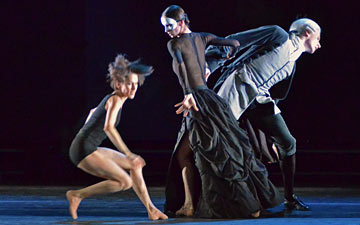
His choreography is busy, occasionally predictable, but more often inventive, strong on musicality and both remarkably fluid and emotionally charged; stretching the dancers both literally and in terms of their artistic diversity.
Tag - George Balanchine
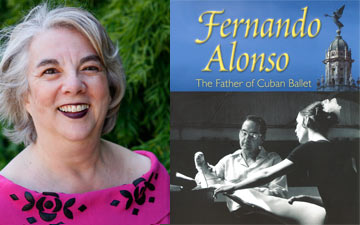
Alonso trained the first generation of Cuban dancers, among who there were many standouts, but the most well-known in Cuba were the “Four Jewels” of Cuban ballet: Josefina Méndez, Mirta Pla, Aurora Bosch, and Loipa Araújo (now Associate Artistic Director of English National Ballet)

Though this year it was Nijinsky’s turn to be reclaimed as a Russian icon, the contents of the gala had little to do with him. Very probably the choice of items – mainly pas de deux - depended on which dancers were available to perform whatever was in their repertoire.
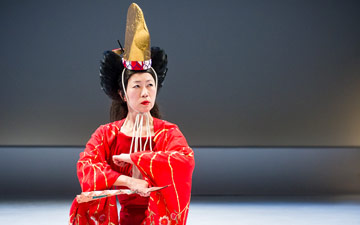
Some experiments sound better on paper - especially when one admires the artist behind them - than they turn out to be in reality.
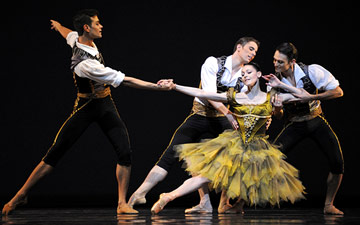
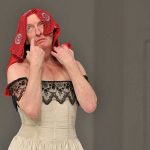
From Foreign Lands: "This amusing, yet subtle send-up of classical ballet is rewarding in its expertly-shaped choreography, and made all the more appealing by the slight wackiness of the costumes and visual jokes."

So how long does he see himself staying on the far side of America? “Well, I am just about to sign another six year contract,” he grinned...
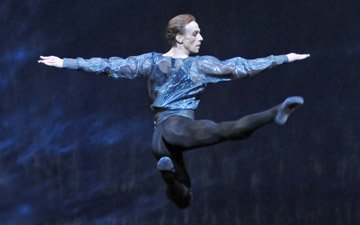
This triple bill, with two world premieres, shows how ably choreographers 85 years apart can refresh the language of classical ballet without distorting it beyond recognition.

27 pictures by Dave Morgan...

Teresa Reichlen - known as Tess by friends and colleagues - is an immediately striking dancer: tall, pale, preternaturally serene. She could be a Madonna in a painting by Botticelli.
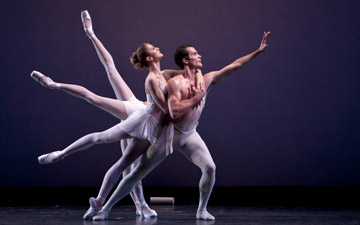
In New York one can begin to feel proprietary about Balanchine, to form the illusion that his choreography is a local specialty, the province of a select group of dancers, all of them employees of New York City Ballet. But this is mere local pride.
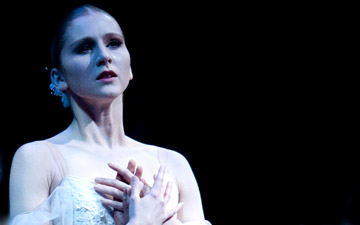
Now thirty-one Carla Korbes has grown up to become one of America’s most remarkable ballerinas. Her recent performance of Terpsichore’s duet with Apollo at the Guggenheim was one of the most touchingly natural and innately musical interpretations I’ve seen.
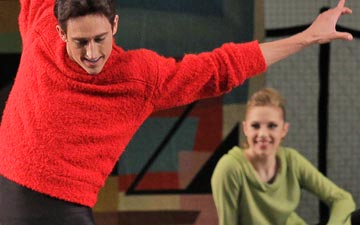
N.Y. Export: Opus Jazz is certainly not Robbins’ finest or most original work but perhaps because of its relative straightforwardness, it reveals much about what is so remarkable about this choreographer.
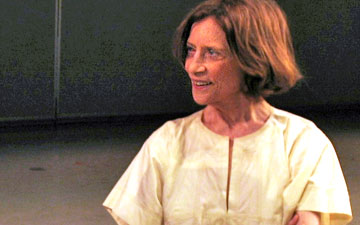
An in-depth interview with the lady who helps bring Balanchine back...
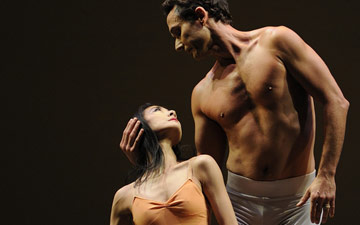
Perhaps the best pas de deux of the evening, judging by the audience reaction, is one from Christopher Wheeldon’s After the Rain.

Is there a ballet more deceptive than Balanchine’s Divertimento from ‘Le Baiser de la Fée’? If so, I’m not aware of it.
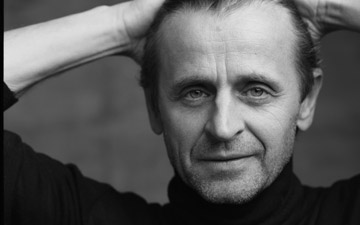
What one does not see much of, at least at first glance, is nostalgia for the motherland. “I never had nostalgia about anything,” Baryshnikov says.
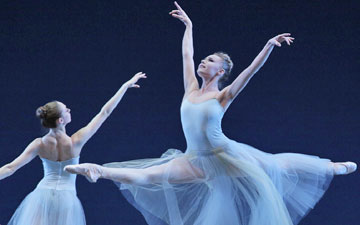
I’m not yet fully convinced of the wisdom of New York City Ballet’s thematic seasons, organized around the music of a single composer....
Dance is a difficult thing to experience outside of the theatre, but for the sustainability of the artform it has to find a way to make itself more widely available.

...it’s that ambiguity in their performances — the tension between seriousness and satire — that makes the company such a joy to watch.
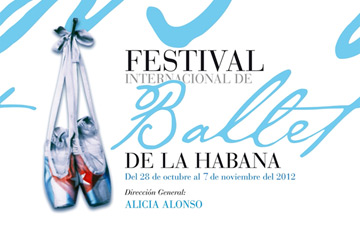
The festival was as intensive as ever, with three performances running on seven days, four on one day, some concurrently. The range and quality of dance overall was impressive.