
Author: Marina Harss

Marina Harss is a free-lance dance writer and translator in New York. Her dance writing has appeared in the New Yorker, The Nation, Playbill, The Faster Times, DanceView, The Forward, Pointe, and Ballet Review. Her translations, which include Irène Némirovsky’s “The Mirador,” Dino Buzzati’s “Poem Strip,” and Pasolini’s “Stories from the City of God” have been published by FSG, Other Press, and New York Review Books. You can check her updates on Twitter at: @MarinaHarss

Under are the articles written for DanceTabs. Reviews on Balletco
Julie Kent and Roberto Bolle in Marcelo Gomes' Apothéose.© Marty Sohl. (Click image for larger version)

American Ballet Theatre – Spring Gala – New York

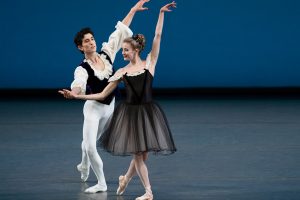
Symphony in C, a luminous outpouring of legs and arms, crisp geometries, bobbing rhythms, and articulate patter-like conversations for the feet, is a vivid reminder of why one goes to the ballet at all. Luminosity and classical logic, laced with wit and intelligence.

Tiler Peck and Robert Fairchild in Christopher Wheeldon's A Place for Us.© Paul Kolnik. (Click image for larger version)

New York City Ballet – Spring Gala with Wheeldon premiere – New York

But ‘A Place for Us’ (new Wheeldon) feels like a bauble, not quite a jewel.

Janie Taylor and Anthony Huxley in George Balanchine's Ivesiana.© Paul Kolnik. (Click image for larger version)

New York City Ballet – Who Cares?, Ivesiana, Tarantella, Stars & Stripes – New York

But stuck in the middle of all this brightness was Ivesiana, like a ghost at a birthday party. It is a most unsettling ballet.

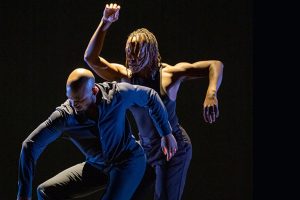
Souleymane Badolo in Barack.© Ian Douglas. (Click image for larger version)

Souleymane Badolo – Boom!, Barack, Buudou, Badoo, Badolo – New York

He dances with his whole body, his head, his feet, his back, his chest, even the tips of his fingers. His movements are full of detail and texture and sensuality, peppered with sudden changes of tempo and force..

Mot Pharan and Sao Somaly in A Bend in the River.© Khvay Samnang. (Click image for larger version)

Khmer Arts Ensemble – A Bend in the River – New York

A Bend in the River is innovative on many levels, but, like all successful advancements, feels both true to its sources and utterly unique.

Dance Theatre of Harlem in Return.© Matthew Murphy. (Click image for larger version)

Dance Theatre of Harlem – April 2013 Revival bill – New York

Johnson has a challenge on her hands. So much potential and so much talent; but what is the mission?

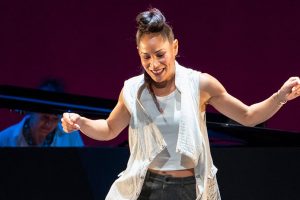
Lil Buck and Yo Yo Ma in in Philip Glass's Orbit (world premiere), part of A Jookin' Jam Session.© Erin Baiano. (Click image for larger version)

Lil Buck – A Jookin’ Jam Session – New York

When he begins to move, you are not just impressed by what he’s doing – which is impressive enough – but also touched by the quiet joy and purity of expression that emanates from his body and eyes.

Jennifer Nugent and LaMichael Leonard in Story/.© Paul B. Goode. (Click image for larger version)

Bill T. Jones – Ravel: Landscape or Portrait? and Story/ – New York

It takes a certain amount of nerve to build a dance season around some of the great masterpieces of the chamber music repertoire. It’s not simply a matter of status in the musical canon; these pieces are strong, they produce emotions, they command attention for themselves. But Bill T Jones is not a timid artist…

Yasuko Yokoshi in Bell.© Ian Douglas. (Click image for larger version)

Yasuko Yokoshi – Bell – New York

Some experiments sound better on paper – especially when one admires the artist behind them – than they turn out to be in reality.

Laura Halzack and Michael Trusnovek in Beloved Renegade.© Paul B. Goode. (Click image for larger version)

Paul Taylor – Cascade, To Make Crops Grow, Beloved Renegade – New York

Beloved Renegade – I’d venture to say that this is one of Taylor’s great works, heartfelt, profound, complex and deeply musical.

Parisa Khobdeh and Michelle Fleet in Offenbach Overtures.© Paul B. Goode. (Click image for larger version)

Paul Taylor – Gala: Junction, 3 Epitaphs, Perpetual Dawn, Offenbach – New York

Opening night was a gala performance; one might have expected Esplanade, or Arden Court, but that’s just not Taylor’s style. For a choreographer who has been criticized for being too popular in his tastes, Taylor can be very odd indeed.

Blakeley White-McGuire in Martha Graham's Imperial Gesture.© Charles Eilber. (Click image for larger version)

Martha Graham Dance Company – “Fall and Recovery” Gala – New York

Even more than with other choreographers, the costumes and sets are essential elements of Graham’s dance imagination. Think of Martha’s stretchy sack-dress in Lamentation, or the prickly metal tree-dress by Noguchi in Cave of the Heart. They are extensions of the dancers’ bodies, and of Graham’s Jungian world-view.

Tadej Brdnik and Blakeley White-McGuire in Phaedra.© Costas. (Click image for larger version)

Martha Graham Dance Company – Phaedra, The Show (Achilles Heels) – New York

To preserve or to progress? And if the latter, how? These questions seem to come up increasingly often as companies grapple with the death of their founding choreographers, artists who created importantant schools of dance in their own image.

Teresa Reichlen.© Paul Kolnik. (Click image for larger version)

Teresa Reichlen – New York City Ballet – Principal

Teresa Reichlen – known as Tess by friends and colleagues – is an immediately striking dancer: tall, pale, preternaturally serene. She could be a Madonna in a painting by Botticelli.

Carla Körbes and Seth Orza in Jean-Christophe Maillot’s Roméo et Juliette.© Angela Sterling & courtesy of Pacific Northwest Ballet. (Click image for larger version)

Pacific Northwest Ballet – Romeo et Juliette – New York

Without Körbes’s natural, radiant dancing, Jean-Christophe Maillot’s Roméo et Juliette, which dominated the company’s four-day run, would have been hard to bear.

Seth Orza, Carla Körbes, Maria Chapman, Lesley Rausch (front-back) in Apollo.© Lindsay Thomas. (Click image for larger version)

Pacific Northwest Ballet – Concerto Barocco, Apollo, Agon – New York

In New York one can begin to feel proprietary about Balanchine, to form the illusion that his choreography is a local specialty, the province of a select group of dancers, all of them employees of New York City Ballet. But this is mere local pride.

Sara Mearns in Serenade.© Paul Kolnik. (Click image for larger version)

Sara Mearns – New York City Ballet – Principal

Sara Mearns has been New York City Ballet’s reigning Swan Queen since her breakout performance in 2006, when she was only nineteen years old and a member the corps de ballet. It was a performance of surprising intensity, edged with danger.

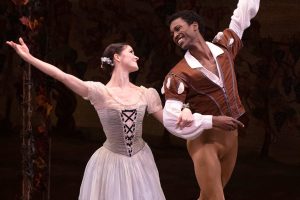
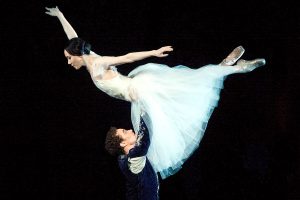
Carla Körbes and Karel Cruz in Giselle.© Angela Sterling. (Click image for larger version)

Carla Korbes – Pacific Northwest Ballet – Principal

Now thirty-one Carla Korbes has grown up to become one of America’s most remarkable ballerinas. Her recent performance of Terpsichore’s duet with Apollo at the Guggenheim was one of the most touchingly natural and innately musical interpretations I’ve seen.

Justin Peck in N.Y. Export: Opus Jazz by Jerome Robbins.© Paul Kolnik. (Click image for larger version)

New York City Ballet – N.Y. Export: Opus Jazz, Waltz Project – New York

N.Y. Export: Opus Jazz is certainly not Robbins’ finest or most original work but perhaps because of its relative straightforwardness, it reveals much about what is so remarkable about this choreographer.

Nancy Reynolds interviewing Edward Villella about Tarantella and Rubies, GBF Video Archives, 2008.© Nancy Reynolds. (Click image for larger version)

Nancy Reynolds – George Balanchine Foundation – Director of Research

An in-depth interview with the lady who helps bring Balanchine back…

DanceTabs © 2013 All Rights Reserved

© All here is copyright DanceTabs and the author concerned. Do not steal our words or pictures please. Thank you.